Monday, May 30, 2011

Santorini

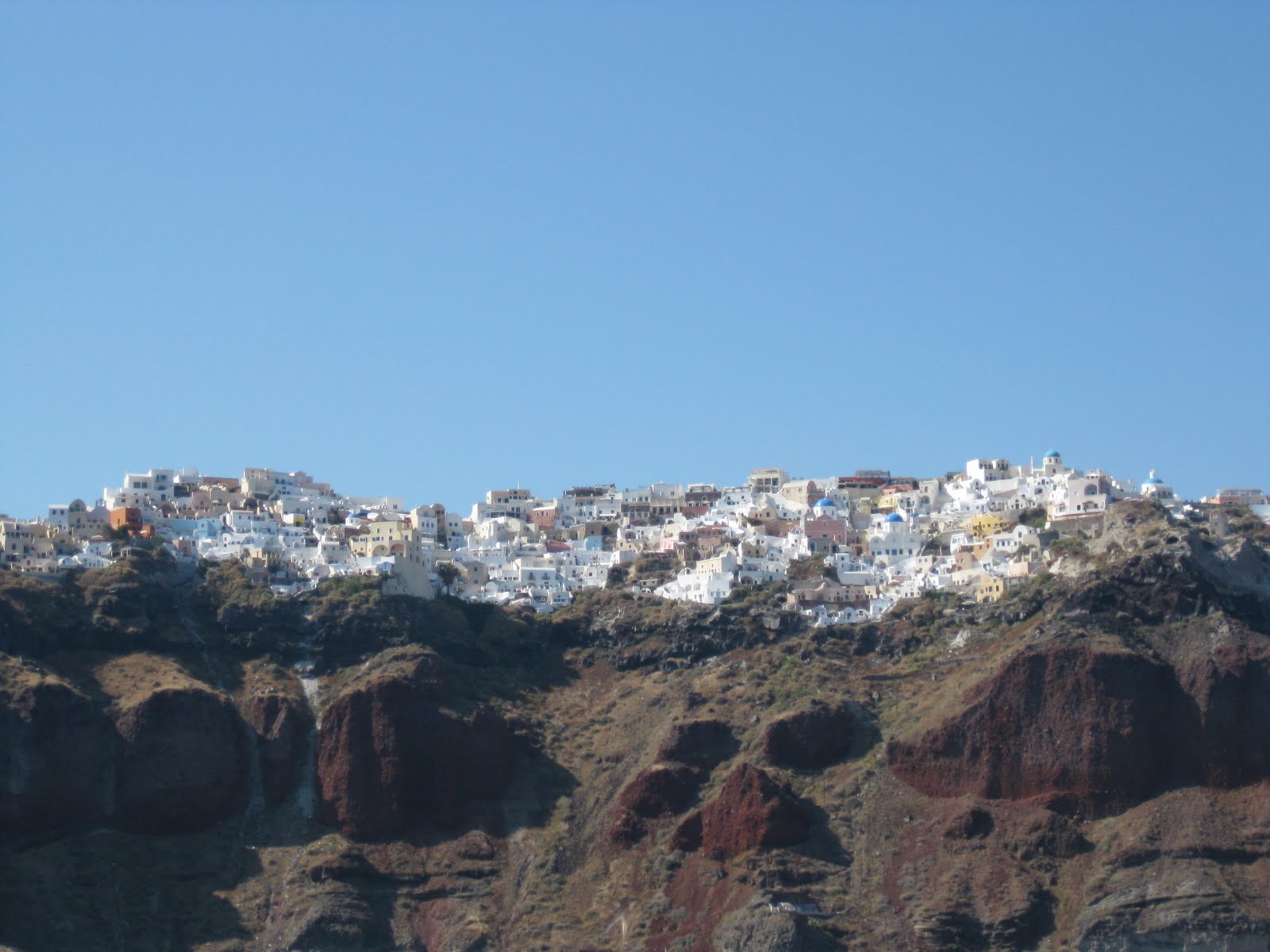
Santorini has quite a reputation.  Everyone I knew who'd been had gushed about how friggin gorgeous it was, so I expected to find it a little overrated. But the island is all it's cracked up to be-  it's friggin gorgeous, and undoubtedly my favourite place I've been in Greece thus far.


What sets Santorini apart is its unusual setting atop cliffs, which makes for spectacular views of the Aegean. The buildings are exactly those you see in postcards and calendars of Greece - white houses, blue, domed roofs, etc. Funnily enough, I haven't come across this architectural style anywhere else in the country. So if that's the Greece you're lookin for, go to Santorini.
A little history:

Originally and still officially, the island is called Thira, (Θήρα). It got its later name, Santorini, from the Latin Empire in the thirteenth century, as a reference to Saint Irene.

In the Bronze Age, roughly between 3000 to 1580 BC, a Minoan settlement thrived on the Southern part of the island. At the time, Thira was a single island, whose inhabitants lived in sophisticated, 3 story houses with advanced drainage systems. They had a dual pipe system, which suggests the use of hot and cold water (the hot water probably heated by the nearby volcano), and toilets. Their elaborate fine art (mostly wall paintings) indicates that they were probably quite wealthy. The settlement's architecture, piping system and the city's layout match up nicely with Plato's description of Atlantis, the mythical lost city. As does the fast, furious destruction of the city by the eruption of the island's volcano:


Plato says in his dialogues Timaeus and Critias (360 BC), that after a failed attempt to invade Athens, Atlantis sank into the ocean "in a single day and night of misfortune."

The eruption occured at some point during the second millenium BCE, although scientists and archeologists are unsure of the exact date. It completely whiped out the settlement there, although the ruins of the ancient town (known today as Akrotiri) were well preserved by the lava, and are often compared to the ruins at Pompeii. Until 2005 (when the canopy over the ruins collapsed and killed a tourist), you could go see the remains of the city. Apparently the canopy is being fixed and the site will reopen soon.

Anyways. The volcano erupted. I'm a little unclear on exactly how the geology goes after this, but from what I can glean online, here's what happened post-eruption: the peak point of the volcano could not sustain the weight from the explosion, so it sank down. Over time, water moved into this deep crater portion of the volcano, forming a lagoon, and the parts of the island that were not submerged became the  "caldera", or cauldron.

Today, Santorini looks from above like a backwards C, whose massive cliffs surround the lagoon on 3 sides. On the fourth side, the much smaller island Therasia separates the 12 by 7 km lagoon from the sea. In the center of the lagoon is the volcano, which we visited by boat. The lagoon (400 m deep) also merges with the sea in at two points, so ferries can easily come in and out of the lagoon to drop off the thousands of tourists who journey to this far-away gem of an island. From cafes atop the cliffs, you can see the boats come in and out, leaving white trails in the blue behind them. All the harbors are situated in the lagoon, not on the outer perimeter of the island, where the land slopes gradually away from the interior cliffs.
I went with Robyn and Whitney. Two of Robyn's friends from DC also joined us, and it was great to have some new blood around. We stayed near Fira, the capital, which perches on top of a cliff at the center of the inverted C. On Thursday night, we went out in Fira, where there are three or four bars that everyone in the town seems to gather at. There were a surprising number of tourists in Santorini, considerin it was only mid-May. I'm really glad we went sooner rather than later, as I imagine it's crawling with tourists by now.
We began our first full day (Friday), with a hearty American breakfast of Ommelettes and toast at "Jerry's" breakfast joint. (We returned to Jerry's on Saturday and Sunday, as well). After breakfast, we rented ATVs and drove around the island. About a mile into the trip, we realized that Whitney's helmet wouldn't stay on her head, Robyn was missing a left mirror (she probably should've noticed that earlier), Sandra's brakes were kinda broken, and my ATV only went 28 k/hour. And the ATV's didn't reverse, so we had to get off and pull them to turn around. Clearly the man at the rental service was awfully concerned about our safety.

We stopped for a midday "snack" at a shoddy looking beachside taverna, which ended up having someof the best Middle-Eastern/Lebanese food I've ever tasted.
Lebanese Food

We returned to our hotel around 6:30, showered and "napped," but then suddenly it was 9:30 pm and we called it a night.

On Saturday, we did the volcano boat excursion. It's a little silly. You go to the volcano and hike a kilometre up to see a tiny hole in the ground, from which thermal, sulphuric air emerges. Everyone goes crazy to get their hands up next to it. And you gotta be careful, because you never know when the volcano's gonna blow - it erupted in 1950!


After the volcano, the boat takes you to the "hot springs" - you jump in the freezing cold water and swim to a rust-coloured, muddy, lukewarm area near the interior. Your bathing suit gets stained brown. It's kindof a strange tourist attraction. I liked seeing goats amble down the hill to observe the humans splashing in the mud, and hearing everyone yell "Fuck its cold!!" in English, French, German, Greek, and Chinese as we swam back out into the cold to be hoisted onto back up to the boat.

After the "hot" springs, we spent some time on the beach of the detached part of Santorini, known as Therasia, before the boat brought us to Oia (top of the Caldera) for the famous sunset. Oia is 300 m up, and you can either walk or take a donkey. We walked, but almost got knocked off the hill by the donkey stampede a few times.


Before sunset, we went to grab a drink at this rooftop bar. Pretty incredible view:


View from the Bar

Ditzy, Delicious Drinks
The sunset is hilarious. Tourists pack onto the Northern slope at Oia like its a movie theatre. As soon as the sun goes down, they file out - show's over. It is a lovely view of the sunset, but if anything on Santorini is overrated, I'd say this is it. But certainly still worth seeing.

That night, we ventured back to Fira for another night on the town. At "Murphys" we met some rather entertaining Australians who had just quit their catering jobs and were travelling in Greece for the next three months. They planned to move to Ios the following Monday, and find some kind of work there. Is it just me, or do most Australians just surf, drink, travel, and find work where they end up?


At lunch on our last day, our kinda-creepy waiter told us he was going to charge us double for our meal because all of us had refused to dance with him the night before. (He had been trying to grope Whitney all night). Although I'm going to miss Greece, I can't say I'll miss the lecherous old men.


On the flight back to Athens, I got to watch the sun set, twice - once while we were down South by Santorini, and then as the plane went North and caught up with the sun, again over the mountains surrounding Athens. Not a bad way to wrap up the trip. :)


Oia


Santorini Screaming Match

Wednesday, May 11, 2011

Parents Part 2 - Crete

When travelling around a Greek island, the hotel shouldn't be the best thing about the trip. There's so much culture and history to see, and the natural landscape is so beautiful, you'd want to get out and explore it, right? Well, sortof. Truth be told, the highlights of our Crete trip - and lowlights, I suppose - were the hotels we stayed in.

Crete, as the largest of the Greek islands, spans 260 km East to West, and 60 km North to South, thus its sheer vastness is what led us to stay in more than one hotel. The first hotel was paradise, the second was so abominable that it deserves its own post (and will get its own post soon). The third, to which we fled from the second, was such a welcome refuge from the second that it could've been a homeless shelter and we'd've loved it.

Crete is incredibly mountainess. From the airport in Iraklion, we could see snowcapped peaks in the distance. The landscape provides a sharp contrast with that of Corfu, because it's so much drier. As we drove towards our hotel, we could almost constantly smell smoke and see it rising up through the mountains, because Cretans burn their trash. Flocks of sheep and small packs of goats lined the sides of the highways.

Kinda Looks like Maine

Sheep
Crete's natural landscape is spectacular. The rugged coastline reminded me of Maine, and I was grateful for that. But to really experience the interior of the island's natural landscape, you need to know your way around. And you need to be comfortable driving in Crete, which is a whole other ballgame, even when compared with driving in Athens. Cretan drivers are freakin insane. During my time in Athens, though I've consistently noted how recklessly Greeks drive, I have witnessed a total of two car accidents. In my four days on Crete, I witnessed three. In Chania, a car backed straight into another parked car, leaving a visible dent, and drove screeching away.

We wanted to drive up to the "Lasithi Plateau," a high plateau which apparently affords extraordinary views of numerous windmills and the surrounding mountains. So up the narrow, winding road we went, a road with no signs, no lanes, and no stopping any Greek driver coming down the mountain at 80 mph from blindly slamming his car right into our own. We made it about 1/5th of the way up and then decided to cut our losses and turn around. Just not worth it.

Mountains!

We wanted to go to the Samaria Gorge, but didn't realize that you could only get there by bus. Of course we missed the bus, which departed at 8 am, and it was raining cats and dogs anyways, so.

600,000 people live on Crete. Approximately 42% of them live in the island's main cities. In my humble opinion, Crete's main cities are not very nice. Iraklion and Aghios Nikhios, on the Eastern side of the island, were tacky, touristy, and unkept. Chania, on the Western side, has a reputation for being a quaint sea-side town. It was cute enough, but packed with tourists and tourist junk. In my eyes, it didn't shine a light to Corfu Town. Even Kritsa, a small village with a reputation as a "traditional example of Crete," was a disapointment. It consisted of little more than a few hilltop streets lined with old Greek women selling lace and men selling the traditional Cretan black riding boots. I think my father put it well when he said of the Cretans: "They're not taking advantage of their advantages." This is arguably one of the most spectacular landscapes on the planet, and yet the towns are so unfortunate looking.

Chania

During these first two days, what excited me most about Crete was our beautiful hotel. The hotel was very modern, and reminded me of why travelling with parents is a good thing - because they'll pay for you not to stay in a shitty youth hostel! The people at the hotel were incredibly friendly. Through speaking to them I realized that Crete has its own specific dialect of Greek, and a very unique accent, different from the Athenians. The food was delicious, I had my own room and my own pool, and a free massage that left me "greased up" and smelling like heaven. This place was paradise.

Night view from Room

Crete was the center of Europe's first advanced civilization, the Minoan civilization of the Bronze Age (2700-1420 BC). The Minoans wrote in Linear A (still undeciphered). Minoan history is the source for the legend of King Minos and the Minotaur. Every year, Minos, the son of Europa and Zeus, chose 7 young boys and 7 young girls to go hang out with the Minotaur in the labrynth. By hang out, I mean wander aimlessly around the labrynth and try to avoid getting eaten by the half-man-half-bull Minotaur. Unfortunately, until Theseus came along with a ball of string to guide him through the maze and slayed the minotaur, the kiddies always got eaten.


We went to visit Knossos, the largest Bronze Age archelogical site, which was "probably" the political center of Minoan civilization. I'm sure it was once a wonderful maze of living spaces, storage spaces, workrooms, etc, but now, it isn't all that impressive. The extensive restoration by archeologist Arthur Evans lends a strange and slightly cheesy air to the site, because the restored parts include many too-colourful wall paintings that look really out of place next to the actual ancient ruins. If I were an archeologist doing restorations, I would try to imagine how what I was restoring would look today, after thousands of years, not as it did in it's original form, because when you put "as it looked then" next to "as it looks now" you get a very odd result. All in all, Knossos doesn't come close to comparison with the resplendent Acropolis.

Minoan civilization is often thought to have collapsed due to the volcano at Thira (Santorini), but this is up for debate.
The best part of Knossos - Peacocks


On our last day we went to the beach. It was a nice beach, but be forewarned if you're ever thinking of travelling to Greek islands - if you want a real "island" experience, come in the summer. Crete, even as the southernmost island, is not warm in late April. It was windy and particularly freezing that day, and there was no chance I was going in the water.

Parting words: While in Crete, my father, impressed with my Greek, told me, "You should consider joining the foreign service." If you know me at all, you'll understand why this is funny.


Saturday, May 7, 2011

Paska in Corfu

Corfu  (Κέρκυρα in Greek, pronounced Kerkyra) is the northernmost and second largest of the Ionian islands, a group of seven islands in the Ionian sea, off of Greece's west coast. The island's name comes from mythology - Poseidon fell in love with the beautiful river nymph Korkyra, abducted her and brought her to this island.


I'm still not sure why it's called "Corfu" in English. This is something that's been baffling me all year - why do we change the names of places for our own languages? A name is a name is a name. For example: Greece, in Greek, is called "Hellada." Wouldn't it make sense for every other country in the world to just call it Hellada, too?

Anyways. Corfu was the beginning of a nine day Greece extravaganza with my parents.

The flight up the coast of Greece over the Ionians was one of the most pleasant flights I've been on - also one of the shortest, at 45 minutes. I was surprised to see how large the island was - as we flew in, it seemed to stretch on forever - (from top to bottom it's around 200 km). 


While waiting for a cab outside of the small airport, my parents got their first taste of Greek melodrama - a cab driver and what seemed to be a paying customer (a man dressed in a fancy beige suit and polished black shoes) had a full on screaming match. They just wouldn't stop yelling at each other, for about 7 minutes straight, ignoring everyone in the taxi lineup. "Then Boro!" the cabby kept yelling. ("I can't!") Other than this, I couldn't make out much of what he was saying, as it was all coming way too fast and furious. Finally he told us to get into his car.

"What was that all about?" my mother inquired. "Oh, that's just my boss," he responded in a very British accent. When asked where he learned to speak English, he responded. "London. Too many English girlfriends."


He drove us through winding streets, full of colourful houses with ornate shutters that looked much more Italian than Greek. Corfu was long controlled by Venice, and you can certainly see the Venetian influence in the architecture near the main town. At one intersection, he pointed to ruins on both left and right of the car - "There, byzantine, there roman," he said. And then he brought us to the wrong hotel.

My mother had been to Greece once before, when she was in her twenties - she and a friend got stuck on Milos for an entire week because they were given wrong directions about which ferry to take and the ferry to Milos only came once weekly. My father had never been to Greece. He has this incredibly annoying tendency of treating all languages other than English as one language, and responding in a strange hybrid of French, Spanish, and Italian to any language that he does not understand. So there was plenty of "si si"ing and "grazi" on this trip. I tried to teach him a few Greek words, like thank you, "effaristo," but he kept saying "effaristimo." At least I was able to teach him the one Greek word to replace his all time favourite word, WANKER - malaka. That one, he could remember.

On our first night, on our way into Corfu town, my father tried to speak his Franglospantalian to the cab driver. I told the cab driver in Greek that my father was crazy. "Ohee," he responded. "Eisa treli, yiati milas Helenika!" - YOU're crazy, because you speak Greek. Very encouraging.
Hangin out the windows to see the celebration

I chose to bring my parents to Corfu because it is THE place to be for easter, and I wanted them to see a bit of Greek tradition. Tens of thousands of people flock to the island for the occasion, wherein different philharmonic bands play (the island has the highest population of musicians of anywhere in Greece), terra cotta pots are thrown from windows, and fireworks light up the sky.
Spit roasted Lamb - traditional Easter dish

Corfu Town looks much more like Rome than anywhere I'd been in Greece thus far. The buildings are grand and ornate, but the town is small enough that it's not overwhelming. We had two lovely (minus the mayaritsa, a traditional soup made of lamb innards) dinners in the outdoor light of Corfu town amidst the Easter celebration.


Because the island is so large, we rented a car. About 5 km down the road we realized there was NO gas in the car, so we almost had a close call in the middle of Corfu town, but luckily were able to get to a gas station in time. I'm really glad we rented a car, because there's a lot to see - the geography of the island is pretty striking. Corfu recieves a pretty heavy rainfall, so it's much more lush than the islands in the Aegean, and doesn't look anything like the rest of Greece that I've seen. As we drove up the North side of the island along the Eastern coast, we could see Albania, which is only about 2 miles away.


At one point we stopped to get out and figure out where we were going and were met by a very friendly, if a little odd, British couple in their mid-sixties. The man, tall, thin and tan with white hair, was smacking away on an ice cream on a stick. "Lost, ah you?" His ginger haired wife flashed us a yellow, crooked toothed grin.  "No, no, just trying to figure out where's best to go... what do you recommend?"  The man finished his ice cream, came over to take a look at the map, and used the stick of the ice cream to point out the best route. I couldn't help looking more at the chocolate and saliva covered stick, rather than the map, as he pointed here and there along the coast and up into the mountains of Corfu. "Don't wanna go up there," he told us, dragging the stick over an area on the northernmost part of the island. "Bit like Blackpool. Not your cup o tea, I'd say."
Mom's fish "soup"

We had a very nice lunch at a little beachside taverna, probably the only place on the island that was open. My mother ordered fish soup, but was told there wasn't any. They recommended something else that was supposedly "similar," and she agreed. Instead she was brought an entire fish carcass covered in brown sauce. At first we were all repulsed, but she found it fresh and tasty.
View from Lunch Table


We drove to a few beaches and little inlets, where the water was crystal clear and turquoise. I went in for a swim, but the water was almost as cold as it is in Maine - really biting. We got lost in the woods, among olive groves, on some seriously winding and narrow roads, and in some little hilltop towns. The driving was pretty hectic and the roads are not very well marked at all. The other towns, aside from Corfu town, were not very well kept, and were pretty tacky from what we could see, which was a bit disappointing. But the landscape made up for it.


My parents were generally pretty impressed with how friendly the Greeks were. After getting lost innumerable times our first day, my Dad was fiending for a beer, so we stopped by a little roadside restaurant to grab something. The owner told us he was closed.. "But come in! I give you something to drink." We ordered a few beers. He introduced himself as Evangelis, and told us all about the island. When we tried to pay, he refused to let us. All he wanted to do was just have a nice chat with some tourists. It was so kind of him.

That's something I've found with Greeks - they generally ARE very very nice, one on one. It's just when it comes to things such as driving, where they're incredibly aggressive, or lines (which they have no concept of), that they can seem rather abrasive. But Greek hospitality is no myth.


Wednesday, April 20, 2011

Madrid, Rome etc

Dear friends:
A lot has happened in my life since my last entry. I went to Madrid, I went to Rome, I had a few visitors here in Athens, I turned 23, I got really really sick,  I felt incredibly lonely and hit my lowest point thus far while in Greece, I got over it, I packed my bag for Santorini, I decided not to go because it was pouring rain, I drew some weird characters and wrote some songs.


First of all, Madrid:


All the buildings look like this


Probably my favourite city I've visited so far. I stayed with a friend who's doing a similar "teach abroad" thing, and spending time with her and her two lovely roommates definitely made the experience. The weather was also great. The architecture is simply stunning, there's plenty of green space, the people were friendly, the food was delicious, the art incredible. I saw a really neat photo exhibit at Caixa Forum, a contemporary art gallery. The exhibition, titled "The Floating World" and composed of photographs by French photographer Jacques Henri Lartigue, dealt with Lartigue's fascination with speed and movement. It's on until June 19th, and I highly recommend it if you're in Madrid. Obviously I also loved the Prado - Goya's da MAN, which I hadn't previously realized. The giant carnival rave dance party in a hockey arena certainly didn't hurt, either. I really have nothing bad to say about Madrid. You should go.


Lartigue photo


Tapas 
Rome:

I'm not going to blab on and on about the architecture. It's beautiful, and it's ubiquitous. But Rome has a certain intensity that Madrid does not, and can feel a little overwhelming. This intense feeling was certainly intensified because I spent most of my time in Rome alone. I stayed with a friend from high school, but she had work and an Italian boyfriend to attend to, so the time I got to spend with her was limited. Luckily I got to enjoy two very nice Italian dinners with her, on the Thursday and Friday nights before she went away with her boyfriend for the weekend. Both nights we went to restaurants in Trastavere, which is a very funky area on the West Bank of the Tiber, south of the Vatican. I would definitely recommend this laid-back area for eating and strolling, if you're ever in Rome.

Trevi Fountain
 On Thursday we went to a very good little pasta restaurant, and were seated very close to a party of six Italian men, who inquired whether my friend had a boyfriend. When she replied yes, they told her that since it was spring, "Prima Vera," it was naturally time to find a new one. On Friday, we went out to drinks with her boyfriend and his friend, who were both very pleasant. However, her boyfriend was one of the most maniacal drivers I've ever been in a car with, and altered my opinion of Greeks as the worst drivers on the planet.

Trees I liked


Spring was certainly in the air - it was warmer in Rome than it's been in Greece thus far. The lovely weather gave me that strange contradictory happy/sad feeling that spring weather does. Although it means new beginnings ("Prima Vera" in Italian, Anoixi - like "opening" in Greek), it also means endings. I guess I feel this sense of simultaneous openings/closings, because spring has always meant the end of a school year, which is both happy and sad. It got me thinking a lot about how my time here is almost up, and scared about what's to come next. I can't believe I only have three months left.


I went to the Vatican without knowing that once you reach the Sistine Chapel, you can't turn around and see the rest of the museum. So I rushed through the entire museum to get to the chapel, and once I'd seen it, that was that and I couldn't turn around. So if you ever go to the Vatican, take your sweet time in the museum. Fortunately, as I was breezing through the museum I did linger for a while in a room full of old maps. There's something very enchanting, almost Narnian, about old maps. A nice break from the Madonna and child, for certain.
Hall of Maps


I thought I would enjoy travelling alone, but I actually found it rather stressful and depressing. This negative feeling was certainly compounded by things going on in my personal life at the time, so perhaps it was just bad timing, but I also realized that you have to be a lot more careful and spend a lot more time figuring out where you are, and that ain't no fun. On my birthday, I nearly burst into tears in the streets of Rome, completely alone. I wasn't in any danger, but I just felt so frustrated not knowing where to go. Navigating on my own was a lot more difficult than I'd expected. I got lost a lot, and not always in the most charming areas.

:(


It also felt a bit strange to have an anonymous birthday, with no one to say "Happy Birthday!" to me except myself. I try not to get too worked up about birthdays because they usually end up feeling like just another day anyways, but being around no one at all that you know on your one special day of the year is an odd feeling. For instance, I went out to my birthday dinner on my own, and I felt like people were just staring at me the entire time wondering why I was alone. I sort of felt like screaming at them, "Fuck off it's my birthday!!!" (but didn't). I also dislike how Italian restaurants sit you so close to the next table. I was right next to an old Italian couple who said maybe three words to each other for the whole meal. I felt like I may as well have been part of their party. Maybe they'd run out of things to talk about. But is that how marriage goes? I hope my parents still have conversations when they go out for dinner.

Later on the night of my birthday, I stood in the Piazza by the Pantheon and watched a four-man string band play live. They were great, and a toddler of about three years old was dancing wildly along. I guess I had a big smile on my face watching this kid dance, because a young man approached me and said, "Your look deserves to be written." I gave him a questioning look and told him to go write about it. "I will, " he said. "I'm a writer," and then showed me the back of his book, on which his picture was plastered. I politely declined to ask him about his book, or himself, nor did I mention that I, too was a writer. Then he said something about the light of the moon and how I was gonna make a great mother one day... European men, man. Could they lay it on any thicker? Ugh.


Cool Green Birdy

I had some interesting experiences in cabs in Rome. My first driver attempted to charge me forty euros for a fifteen minute cab drive, after he turned off the meter when we crossed over the Tiber. "The meter doesn't work on this side," he said, "so it's another price." Jerk. I gave him twenty five and got out.  Another, much kinder one, actually gave me more change back than was owed, simply because I had helped him practise his English. All he knew how to say was, "I have run out of food."


Back in Greece..
I think being in Rome alone set something in motion inside of me that made me feel really really lonely, even back in Greece. There's also been some rather unfortunate stuff going on (or not going on) in my personal (read:romantic) life that has been rather upsetting, and has had a more profound effect on my state of mind than I'd like to admit. I could go on and on about that, but that's not what this blog is about.

Anyways - after I got back from Rome, I got really really sick. In Romeo and Juliet (which we finally have finished in my grade ten classes), after Mercutio's famous Queen Mab speech, Mercutio tells Romeo, "True, I talk of dreams, which are the children of an idle brain." So sometimes is misery, in my opinion.

This was the lowest point I've had so far while in Greece. It's funny, because I'd always expected the hardest part to be the beginning, but the beginning was easy as pie. My bad mood didn't stem from anything culturally related, but instead from being sick in bed with an idle brain, with nothing to do and no one to talk to. It kinda caught me off guard.

Anyways, I'm doing much better now. Currently I am on my two week vacation from school for PASKA (Easter). This past Sunday I was supposed to go to Santorini but opted not to because of bad weather. These few days at home in the apartment have actually been incredibly productive, and now that I'm healthy my brain is not so idle. I've been playing a lot of guitar and drawing weird characters inspired by a Greek artist named Christina Christoferou, who illustrated the cover of "The Magus," the total mindfuck of a book I'm currently reading. Tomorrow my parents are coming to Greece (hooray!) and we are off to Corfu for a true Greek Easter celebration, then to Crete.

New friends


Let the sun shine.

Come visit me in Greece, already.


Tuesday, March 8, 2011

Turkish Delight

The other weekend I went to Asia.
I'm talking about Istanbul.

I was there for less than forty-eight hours and the weather was absolutely wretched (freezing rain), and still I had a wonderful time. Strolling around freezing in my inadequate cloth footwear, I kept thinking, "I've gotta come back here when it's warm again." I sure hope I get the chance to.
It was really f-ing cold


In 324,  Emperor Constantine I defeated Licinius, and came to effectively rule the entire Roman Empire. Shortly thereafter, he decided to build a new, Christian city to replace Byzantium: Nea Roma. Most people simply called it Constantinople. The city became a center of Greek culture and Christianity, and shifted Roman power eastward.

For a while, the city's seafront and its walls protected it from invaders from the east and against the advance of Islam. But things started to go sour after the Fourth Crusade. The city was sacked and pillaged in the early 1200s, and unfortunately never quite bounced back. In the mid 14th century, the Ottoman Turks began taking small towns and cities one by one, slowly strangling Constantinople by cutting off its supply routes.

Finally, in May of 1453, the last Roman Emperor (Constantine XI) was killed, and Sultan Mehmed II captured the city and declared it the new capitol of the Ottoman Empire. Hours later, the sultan rode to the Hagia Sofia and summoned an imam (islamic priest) to proclaim the Islamic creed and convert the cathedral into an imperial mosque. 

And still, all my students refer to it as Constantinople. Get over it, Greece, it was over 550 years ago.

 Check out this song about it:
(Originally written by "The Four Lads" but I like this version better.)


Mandee, Whitney and I left Athens two Fridays ago around 7 pm, and arrived at our hostel by 10. Living conditions certainly colour an experience, so I think "Bauhaus Hostel" deserves a large amount of credit for my enjoying Turkey so much. Immediately upon our arrival the man at the front desk told us there was a "bellydancing show upstairs!!!" and that we had better "run!!" in order to catch it before it ended. We climbed three flights of stairs to increasingly loud music and came upon a pretty happening bar on the top floor. A gorgeous young Turkish woman, clad rather scantily in a sparkling bellydancing costume, shook her booty in front of roughly thirty young beer-drinking onlookers. Aside from the bellydancer, it felt more like Brooklyn than Istanbul - the audience looked out from behind many a pair of horn rimmed glasses and flannel shirts.

After we changed and freshened up, we went back upstairs for another drink. There we met two American boys, Zach and David, who decided to join us for dinner. That's one of the (only) great things about hostels - everyone knows no one knows anyone, so everyone hangs out. We ventured out into the cold Turkish night and found a kebab joint. The old Turkish owner brought us chicken skewers and rice and repeatedly referred to us as his daughters.

Bauhaus is located in the Old City, right by the Blue Mosque and Hagia Sofia. The streets are entirely cobblestone. People had told me that Istanbul is a crazy busy place, like New York, but our section of the city felt quiet and calm.

On Saturday morning we first set out for coffee, and settled upon our location based on the lights. Here we had our first taste of apple tea; apple tea is delicious, especially on such a miserable day, but it's basically just hot koolaid. (I bought some at the airport- ingredients= sugar).


Perhaps I oughtn't judge a city by it's stray animal population, but I was struck by how good lookin' the stray dogs in Istanbul were. They just looked so dignified. The ones in Athens are so FAT - these were some lean, adoptable, playful lookin pooches.

Check out those crossed paws 

Hagia Sofia
                                                                                                                                                             The Hagia Sofia as we see it today was commissioned (for a third time) by Byzantine Emperor Justinian. He was determined that it be ENORMOUS, and ordered that only the richest materials be used.  It was decorated over a period of 26 years, with precious gold, silver and marble, taken from far away lands. Hollow bricks from Rhodes were used to construct the domed ceiling.

Everything in Istanbul is very ornate - I loved the colourful, finely detailed glass lamps on the ceilings of all the restaurants we ate in, the handpainted dishes, the intricate wall paintings in the mosques. I especially liked the walls of the Blue Mosque. I was surprised to feel so drawn to an Islamic aesthetic, because I usually think of Islam as so foreign, and as something that makes me uncomfortable. Similarly, the call to prayer: I thought it would kinda freak me out. I loved it. It's fascinating, haunting, beautiful.


I really liked the Turks I met on this trip. I found them very friendly, and that they had quite a sense of humour. People had told me that the men there would be incredibly aggressive, and I did find this to be true, but not in the way I expected. In Greece, you have to put up with a lot of stares and hearing how beautiful you are. (I read somewhere that Greek men rank #1 in the world for sleaziness. Woo!) In Turkey, the only men who really hassled me were those who wanted me to buy something - the men in the bazaars and standing outside restaurants. They really, REALLY want YOU to buy their product, and they let you know it. They shout after you loudly if you walk away, as though they're incredibly offended. It's pretty annoying, and a terrible sales tactic, but hey: at least there was no groping.

Lights in the Grand Bazaar
My favourite part of the trip was wandering through the bazaars, (Grand Bazaar and Egyptian Spice Bazaar). Here you experience a sensory overload - the smells of spices and apple tea, the free samples of Turkish delight, the bright warm light of countless lamps, the shouting after you as you walk away from a stall in an attempt to bargain. Bargaining is expected. You certainly hear a lot of, "This? forty, but for you, 25," and wonder for whom the price ISN'T specially discounted. Still, it's a fun game to play. I think I also loved the Bazaars because they were such a nice warm refuge from the horrible wintry mix outdoors. I kinda went overboard on the scarves.


Teas and Spices
I also quite enjoyed the Basilica Cistern, or "Sunken Cistern," the largest of several hundred cisterns that lie beneath the city. It is close to 10,000 square meters, and can hold 80,000 cubic meters of water. Large fish swim in the water, their scales reflecting the orange glow from the sparse lighting. A forest of columns extends from below the water to the ceiling. I put on my ipod, and as I listened to Beethoven, I tried to imagine that it was just me and the fish.

Basilica Cistern

Our Restaurant Saturday
Aladdin
Saturday lunch was delicious. Hummus, Turkish ravioli, some kinda eggplant thing, and more apple tea. And of course, lamps galore overhead. The owner then insisted we go visit his "museum" upstairs, which looked much more like an opium den. Totally bizarre - there was a girl typing away on her macbook on one couch, and what looked like an older version of Aladdin lying on some floor pillows. Costume clothing everywhere. I couldn't tell if he wanted us to buy drugs or what, but it certainly seemed like an inviting space to just lie down and sleep.

We went to the other side of the Bosphorus, Taksim, on Saturday night for dinner. THIS was the NYC, super hyped happening city I had heard of. It was nuts. Unfortunately for us, we didn't realize that Turks don't eat as late as Athenians do - showing up at a restaurant at eleven pm for dinner didn't really fly. So we had to settle on fast food. Good all the same.

Fruit Market on the Asian Side

On Sunday we awoke early and hit up the blue mosque, then went down to the water to take the ferry over to ASIA! The Asian side wasn't nearly as nice, in my opinion, but we also didnt really have a clue where we were going. The weather was also terrible.


Speaking of weather, we're having a snow day today in Greece. :)